
Leave Your Message
Enterprise Core Values
Passion,Strive,Pragmatism,Promising
Corporate Vision
To become a global leader in smart energy storage
Corporate mission
Let clean energy enter thousands of households
Selecting the correct cable size is a critical step in the design and installation of energy storage systems (ESS). Proper cable sizing directly affects system safety, efficiency, voltage stability, and long-term reliability. Undersized cables may lead to overheating, excessive voltage drop, and energy loss, while oversized cables increase unnecessary system costs.
Why Cable Size Matters in Energy Storage Systems
In battery energy storage systems, cables carry high DC and AC currents for extended periods. Correct cable sizing ensures:
Stable long-term charge and discharge performance
Reduced power loss and heat generation
Compliance with electrical safety standards
Reliable operation in parallel and high-power systems
Easier system integration with inverters and PCS units
For EPC contractors and installers, clear cable sizing guidance also helps reduce installation errors and post-installation maintenance risks.
Key Factors Affecting Cable Size Selection
Before selecting a cable size, the following factors should be evaluated:
1. System Voltage Level (48V, 96V, 400V, 800V, etc.)
2. Maximum Charge and Discharge Current
3. Cable Length and Installation Distance
4. Parallel Configuration (number of battery units)
5. Ambient Temperature and Installation Environment
6. Local Electrical Codes and Standards
COMMON CABLE APPLICATION POINTS IN ESS
Energy storage systems typically require cables at several key connection points:
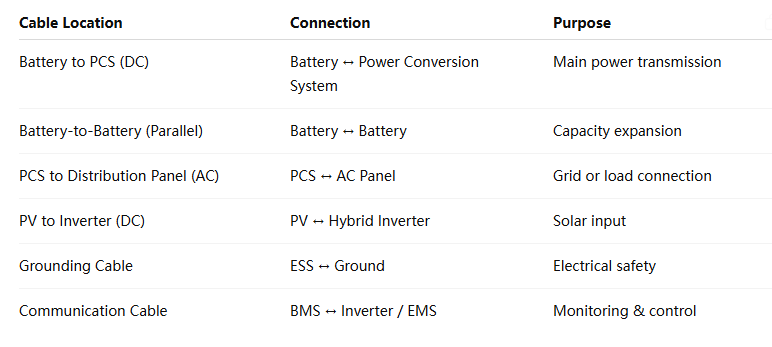
Recommended DC Cable Sizes (Battery to PCS)
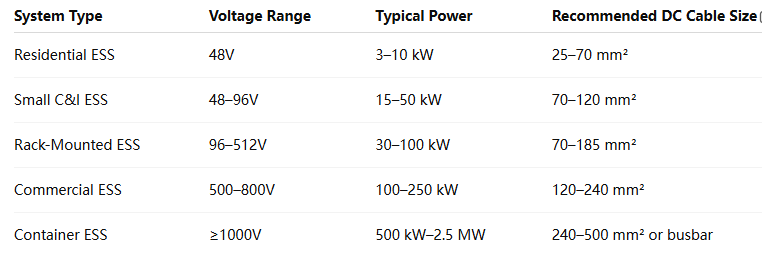
DC cables handle the core power flow in energy storage systems. The table below shows commonly used cable size ranges based on system type and voltage.
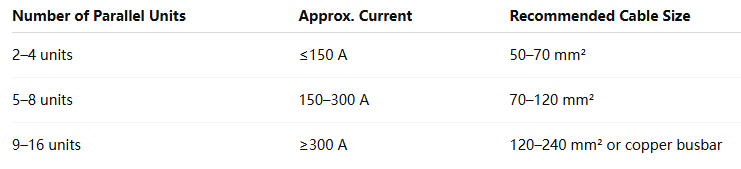
Battery Parallel Connection Cable Size
When multiple battery units are connected in parallel, current increases significantly. Cable size must scale accordingly.
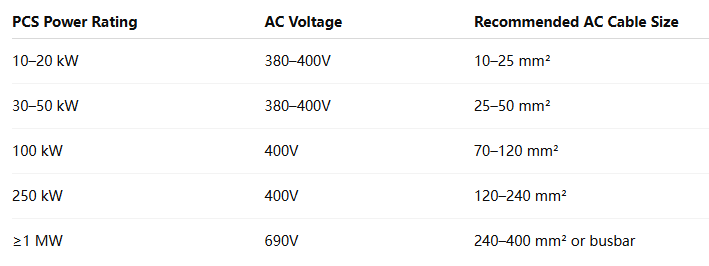
Recommended AC Cable Sizes (PCS to Distribution Panel)
AC cable selection depends on PCS power rating and output voltage.
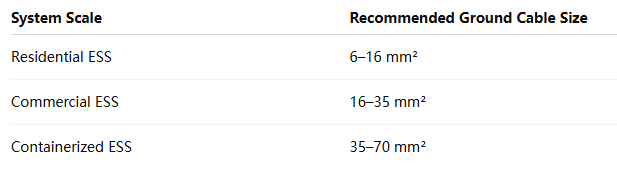
Grounding Cable Recommendations
Proper grounding is essential for ESS safety and compliance.
Best Practices for ESS Cable Selection
Always select cable size based on maximum continuous current, not nominal power
Allow margin for future expansion in modular ESS designs
Use certified copper cables with appropriate insulation ratings
Minimize cable length to reduce voltage drop and power loss
Follow inverter and battery manufacturer recommendations
Conclusion
Choosing the right cable size for energy storage systems is essential for safe, efficient, and reliable operation. By understanding system voltage, current requirements, and installation scenarios, EPCs and installers can significantly improve system performance and reduce long-term risks.
Manufacturers that provide clear cable size guidelines help simplify installation and improve customer satisfaction across residential, commercial, and utility-scale ESS projects.
For more technical resources, system design guides, and energy storage solutions, visit the Suness Energy Storage official website and explore our full range of lithium battery and ESS products.
Leave Your Message
Enterprise Core Values
Passion,Strive,Pragmatism,Promising
Corporate Vision
To become a global leader in smart energy storage
Corporate mission
Let clean energy enter thousands of households