

Leave Your Message
Enterprise Core Values
Passion,Strive,Pragmatism,Promising
Corporate Vision
To become a global leader in smart energy storage
Corporate mission
Let clean energy enter thousands of households
Choosing the right LFP battery supplier is essential for battery distributors, wholesalers, solar installers, and energy storage system integrators. A reliable supplier can help ensure consistent product quality, stable supply, technical compatibility, and long-term business growth.
However, not all lithium iron phosphate (LFP) battery suppliers offer the same manufacturing capabilities, product specifications, certifications, or after-sales support.
To choose a reliable LFP battery supplier, buyers should evaluate battery cell quality, manufacturing capability, safety certifications, BMS compatibility, cycle life, warranty terms, delivery reliability, and total cost of ownership—not just the initial purchase price.
This guide explains the key factors B2B buyers should consider before selecting an LFP battery manufacturer or energy storage battery supplier.
1. What Is an LFP Battery Supplier?
An LFP battery supplier provides lithium iron phosphate batteries or battery cells for applications such as residential solar storage, commercial and industrial energy storage, backup power, and renewable energy projects.
LFP, also known as LiFePO4, is widely used in stationary energy storage because of its thermal stability, long cycle life, and suitability for frequent charging and discharging.
Depending on the supplier, available products may include:
LFP battery cells, including 280Ah and 314Ah formats
Residential lithium battery storage systems
Low-voltage 48V energy storage batteries
High-voltage battery systems
Commercial and industrial battery storage cabinets
Containerized battery energy storage systems (BESS)
Customized battery solutions for OEM and ODM projects
Before contacting a supplier, buyers should identify whether they need individual battery cells, complete battery packs, or integrated energy storage systems. Each category requires different technical evaluations and purchasing considerations.
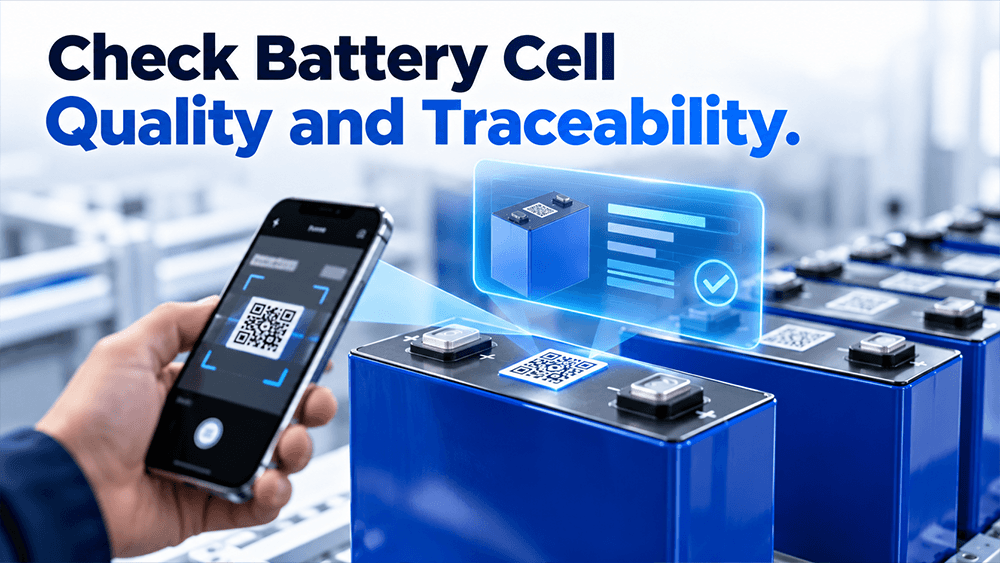
2. Check Battery Cell Quality and Traceability
Battery cells are the foundation of an LFP battery system. Their quality and consistency directly affect battery performance, capacity retention, and long-term reliability.
When evaluating an LFP battery supplier, ask the following questions:
Who manufactures the battery cells?
What is the cell model and rated capacity?
Are the cells new and traceable to their production batches?
Are cell capacity and internal resistance tested?
How are cells inspected and matched before assembly?
Can the supplier provide relevant technical specifications and test records?
Why Does Grade A LFP Cell Quality Matter?
Many suppliers advertise Grade A LFP cells, but buyers should not rely on this label alone.
A professional supplier should be able to explain its incoming inspection procedures, cell matching process, quality-control standards, and batch traceability arrangements.
For customers purchasing cells in bulk, these checks are particularly important because cell consistency can affect battery pack integration and overall system performance.
For example, buyers comparing 280Ah and 314Ah LFP battery cells should consider rated capacity, cell dimensions, energy density, internal resistance, cycle-life conditions, and system compatibility.
Buyer tip: Request the cell datasheet, manufacturer information, batch identification details, and available test documentation before placing a large order.
A company selling lithium batteries is not necessarily the manufacturer of those products.
For distributors and project developers, understanding a supplier's actual production capability can help reduce supply-chain risks and improve purchasing confidence.
Evaluate the following areas:
| Evaluation factor | What to check |
|---|---|
| Manufacturing facilities | Does the supplier operate its own production facility or rely entirely on external factories? |
| Quality control | Are incoming materials, battery assembly, and finished products inspected? |
| Production testing | Are capacity, voltage, protection functions, and other relevant parameters tested? |
| Traceability | Can finished products be traced through serial numbers or production records? |
| Production capacity | Can the supplier support your expected order volume? |
| Engineering support | Can the technical team help resolve product configuration and compatibility issues? |
| Customization | Are OEM, ODM, or other customization services available when required? |
For long-term distribution partnerships, consistent production quality and reliable repeat orders are often more valuable than a low initial quotation.
If possible, request a factory audit, a remote production walkthrough, or a sample evaluation before committing to a substantial order.
Certifications are an important part of supplier evaluation, especially when importing lithium batteries into overseas markets.
However, certification requirements vary according to the product type, installation environment, destination country, and intended application.
Depending on the product and market, relevant documents or standards may include:
UN 38.3: Lithium battery transport testing requirements.
IEC 62619: Safety requirements for industrial lithium batteries.
UL 1973: Safety requirements for batteries used in stationary and other specified applications.
UL 9540: Safety requirements for energy storage systems and equipment.
CE marking: Applicable European conformity requirements for products within the relevant regulatory scope.
ISO 9001: Quality management system certification for an organization.
These standards and certifications are not interchangeable. For example, a transport test report does not establish that a complete energy storage system meets every installation safety requirement.
Before placing an order, ask the supplier to provide the applicable certificates, test reports, and model numbers. Verify that the documents cover the exact battery product or system configuration being offered.
For B2B buyers, confirming compliance before shipment can help reduce the risk of customs delays, installation issues, and project approval problems.
The battery management system (BMS) monitors battery operating conditions and provides protection functions according to the system design.
A battery with suitable cells may still be unsuitable for a project if its BMS cannot communicate correctly with the selected inverter or energy management system.
Before purchasing, check the following:
Battery voltage and capacity
Continuous charge and discharge current
Overvoltage and undervoltage protection
Overcurrent and temperature protection
Cell monitoring and balancing functions
CAN or RS485 communication support
Supported inverter models and communication protocols
Remote monitoring and troubleshooting capabilities
For residential solar storage, compatibility with the intended hybrid inverter is particularly important.
For commercial and industrial applications, buyers may also need to evaluate communication between the battery management system, power conversion system (PCS), and energy management system (EMS).
Buyer tip: Do not assume that two batteries are compatible simply because they share the same nominal voltage or communication interface. Confirm the supported protocol, configuration requirements, and compatibility with the specific inverter model.
Cycle life is one of the most frequently advertised specifications for LFP batteries. However, cycle-life figures should always be evaluated alongside their test conditions.
For example, a battery advertised with 8,000 cycles should be assessed according to its specified depth of discharge (DoD), operating temperature, charge and discharge rates, and end-of-life capacity threshold.
When comparing suppliers, ask for:
Rated capacity and usable capacity
Cycle-life test conditions
Recommended depth of discharge
Operating temperature range
Charge and discharge current limits
Energy efficiency specifications, where applicable
Capacity retention or degradation information
Expected service-life assumptions
A higher cycle count does not automatically mean a better battery. The actual value depends on the application's operating profile and the conditions under which the performance figures were established.
For instance, a residential battery used for daily solar energy storage may have different operating requirements from a commercial battery used for peak shaving or backup power.
Buyers should match the battery specifications to the intended application rather than compare individual figures in isolation.
A reliable LFP battery supplier should provide clear warranty terms and a practical process for handling product issues.
Before purchasing, confirm:
Warranty coverage
What is the warranty period?
Which components are covered?
Are there operating conditions or exclusions?
Is minimum capacity retention guaranteed, and under what conditions?
Technical support
Can the supplier provide installation and commissioning guidance?
Is remote troubleshooting available?
Can technical questions be handled promptly?
Replacement and repair
What is the procedure for reporting a defect?
Are replacement parts available?
Who is responsible for shipping, labor, or related costs under the warranty?
Overseas service
Can the supplier support your target market?
Are spare parts and replacement products available?
Is there a clear process for technical escalation?
For overseas distributors and installers, responsive technical support can help protect customer relationships and reduce the operational impact of product problems.
Always review the written warranty document rather than relying solely on verbal assurances or general marketing statements.
Price is important, particularly for wholesalers and distributors purchasing in volume. However, the lowest initial quotation does not necessarily represent the best overall value.
Battery quotations can vary because of differences in cell specifications, BMS functions, product configuration, certification scope, warranty coverage, packaging, shipping terms, and order quantity.
When comparing quotations, make sure that all suppliers are quoting on the same basis.
| Cost factor | Questions to ask |
|---|---|
| Battery price | Is the quotation for cells, battery packs, or a complete BESS? |
| Product specifications | Are capacity, voltage, current, and configuration equivalent? |
| Certification | Are the required documents included and applicable to the exact model? |
| Warranty | What is covered, and what costs are excluded? |
| Shipping | Are freight, insurance, and destination-related charges included? |
| Installation | Does the quotation include installation or commissioning? |
| Maintenance | What routine maintenance or service costs should be expected? |
| Replacement | What are the potential costs of replacing components or batteries? |
For project-based procurement, total cost of ownership may include the initial purchase price, installation, energy losses, maintenance, replacements, and other operating expenses over the expected service life.
For distributors, the evaluation should also consider repeat-order consistency, delivery reliability, technical support, and the potential cost of customer complaints or warranty claims.
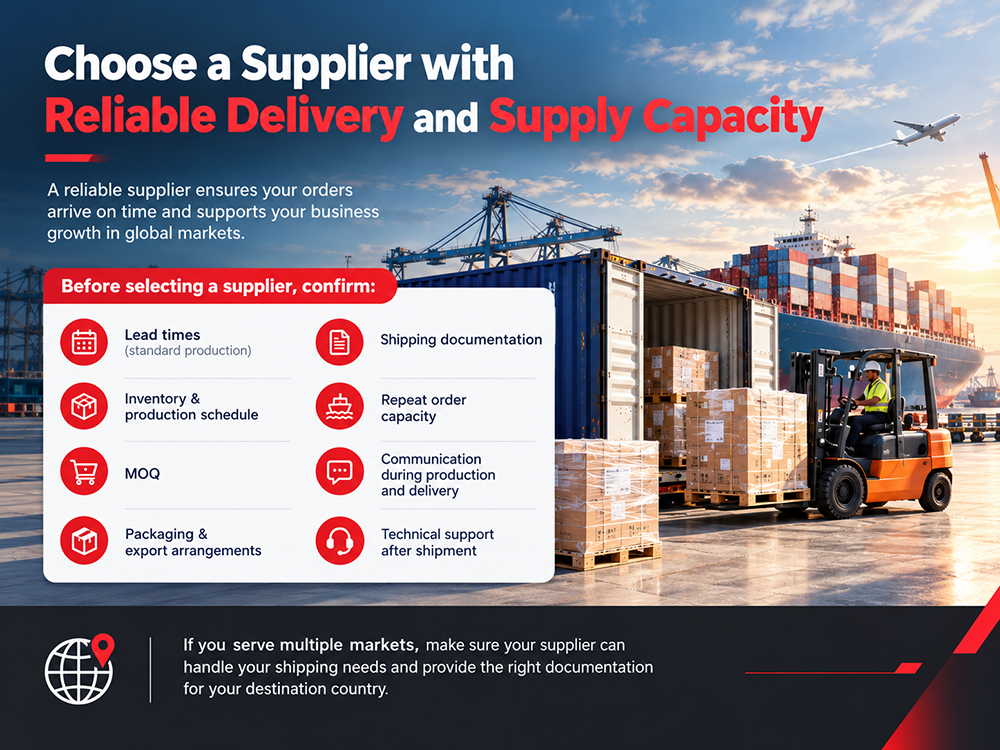
A technically suitable battery is of limited value if it cannot be delivered when a project needs it.
Supply-chain reliability is especially important for overseas wholesalers, distributors, and installers managing multiple customer orders.
Before selecting a supplier, confirm:
Standard production lead times
Available inventory and production scheduling
Minimum order quantities
Packaging and export arrangements
Shipping documentation
Capacity to support repeat orders
Communication during production and delivery
Availability of technical support after shipment
If your business serves multiple markets, ask whether the supplier can accommodate your shipping requirements and provide the documentation needed for your destination country.
For recurring orders, consider agreeing on forecast schedules and communicating demand changes early. This can improve planning for both the buyer and the supplier.
10. Manufacturer or Trading Company: Which Should You Choose?
Both direct manufacturers and trading companies can serve legitimate business needs. The right choice depends on the product, order size, technical requirements, and service expectations.
Comparison factor
Direct manufacturer
Trading company
Product communication
Direct access may be available to production and engineering teams
May coordinate through external factories
Customization
May offer more direct control over product configuration
Depends on factory relationships and project requirements
Product traceability
Can be easier to verify when manufacturing records are accessible
Depends on the supplier's documentation and sourcing process
Product selection
Often focused on its own manufacturing range
May offer products from multiple manufacturers
Pricing structure
May provide direct factory quotations
May offer consolidated sourcing and procurement services
After-sales support
Depends on the manufacturer's service network
Depends on the company's support arrangements
Buying directly from a manufacturer can be useful when you require customized battery configurations, technical communication, repeat orders, or long-term supply cooperation.
A trading company may be suitable when you need products from multiple manufacturers or prefer a consolidated procurement arrangement.
In either case, verify product quality, certification documents, warranty responsibilities, and the actual source of the batteries before making a decision.
11. Why Consider SUNESS for Energy Storage Battery Supply?
SUNESS provides lithium battery products and energy storage solutions for residential and commercial and industrial applications.
For B2B buyers, the product portfolio includes several categories to evaluate according to project requirements:
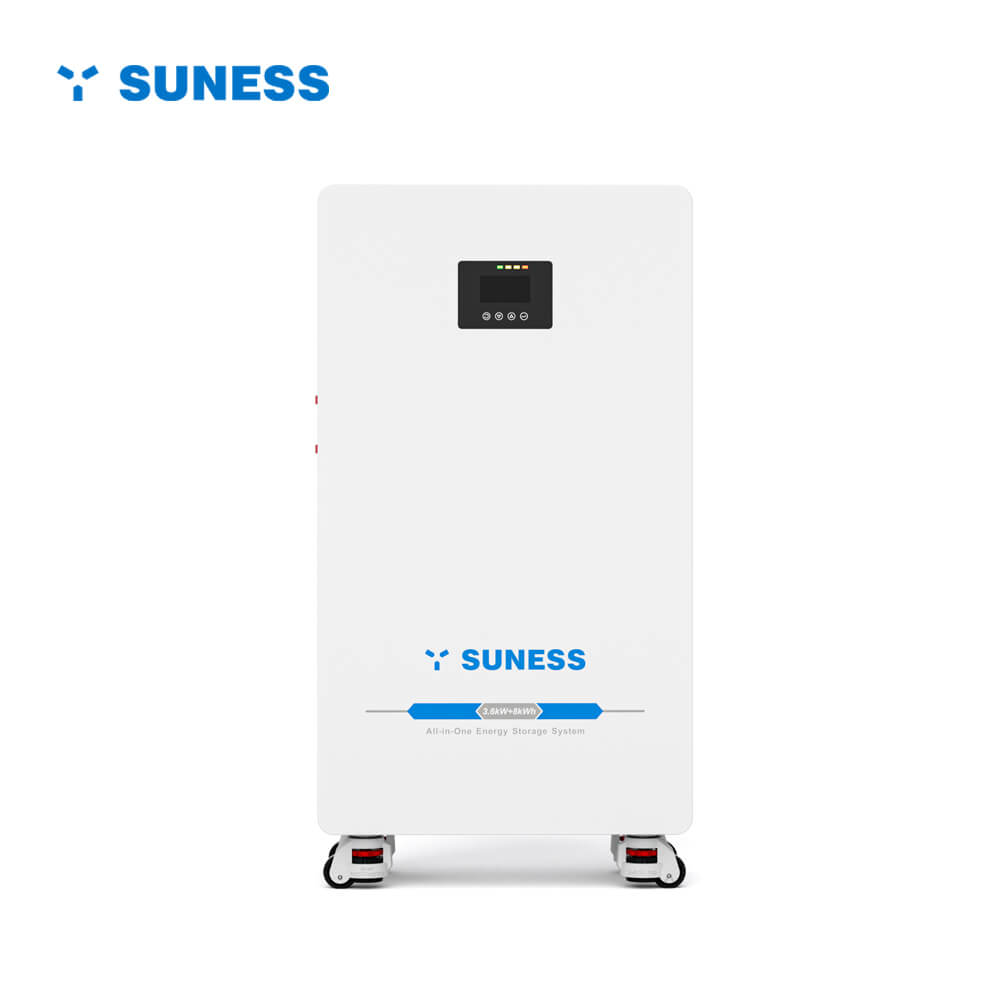
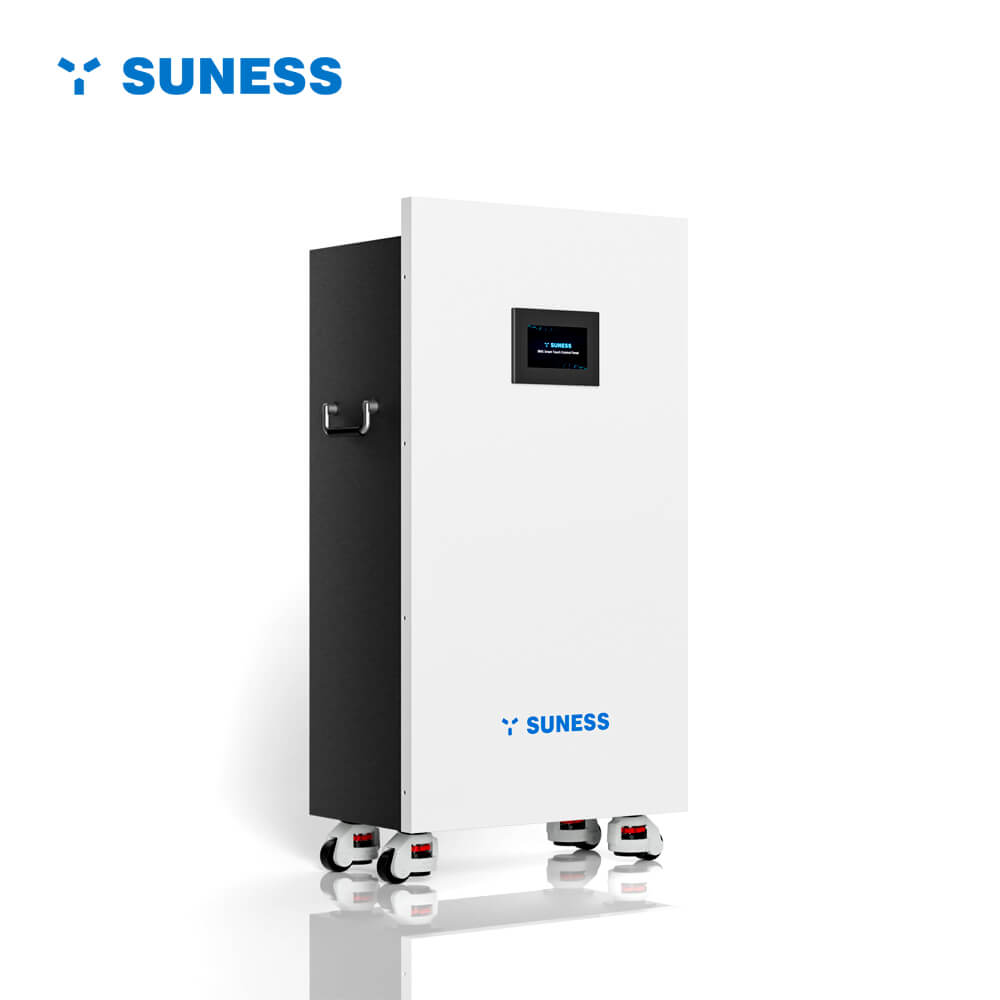
Residential LFP batteries
Designed for suitable residential solar storage and backup power applications, with different capacity options for different household energy requirements.
High-voltage energy storage systems
Designed for compatible applications requiring higher-voltage battery configurations and scalable storage capacity.
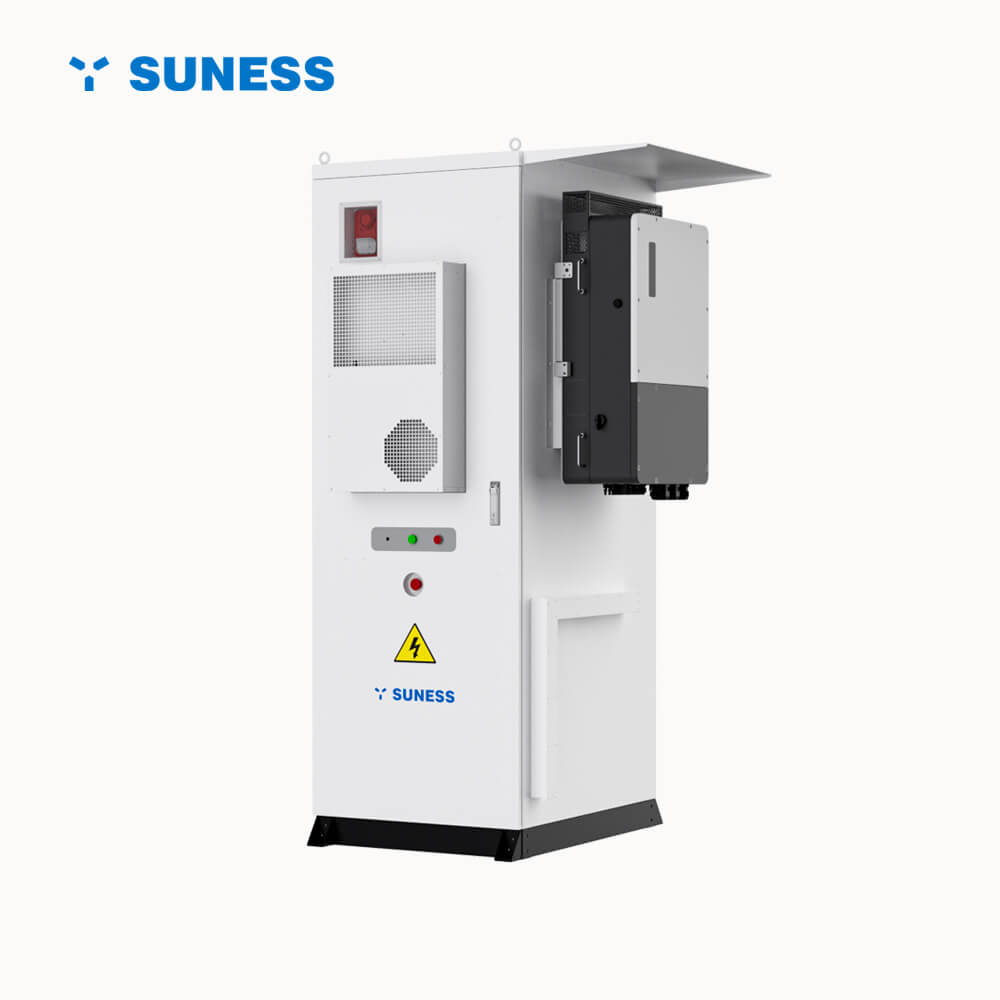
Commercial and industrial energy storage
Battery cabinets and larger storage solutions for businesses evaluating backup power, solar energy utilization, and energy management.
Battery cells
Cell options for buyers evaluating battery sourcing, system integration, and energy storage manufacturing requirements.
When evaluating SUNESS or any other supplier, buyers should confirm the specifications of the selected model, available certifications, warranty terms, compatibility requirements, and delivery arrangements.
For distributors, wholesalers, installers, and project developers, these checks provide a practical basis for comparing suppliers and identifying a suitable long-term business partner.
Contact SUNESS to discuss your battery capacity requirements, target applications, product configurations, and B2B supply needs.
12. LFP Battery Supplier Selection Checklist
Before placing an order, use the following checklist to compare potential suppliers.
Evaluation item
Questions to confirm
Battery cells
Is the cell manufacturer and model identified?
Cell quality
Are inspection and traceability records available?
Manufacturing
Can the supplier demonstrate its production and quality-control processes?
Certifications
Do the documents cover the exact product and target market?
BMS
Are protection functions and communication protocols suitable?
Cycle life
Are the test conditions and capacity-retention criteria documented?
Warranty
Are coverage, exclusions, and replacement procedures clear?
Compatibility
Has compatibility with the intended inverter or system been confirmed?
Delivery
Are lead time, shipping terms, and repeat-order capacity acceptable?
After-sales
Is technical support available for your market?
Pricing
Are quotations based on equivalent specifications and delivery terms?
Long-term supply
Can the supplier support your forecast demand?
The best supplier is not necessarily the one with the lowest quotation. It is the one that meets your technical requirements, provides verifiable documentation, delivers consistent products, and supports your business over time.
Evaluate battery cell quality, manufacturing capability, applicable certifications, BMS compatibility, cycle-life test conditions, warranty terms, delivery reliability, and after-sales support. Compare suppliers using the same technical and commercial requirements rather than price alone.
Request the battery datasheet, cell manufacturer and model, BMS specifications, applicable certificates, test reports, warranty document, production lead time, inverter compatibility information, and shipping requirements.
For large orders, also discuss sample testing, production consistency, and repeat-order availability.
The required documents depend on the battery type, intended application, and destination market. Relevant requirements may include UN 38.3 for transportation, IEC 62619 for industrial battery safety, and applicable UL or regional requirements for stationary storage systems.
Always verify that the documents apply to the exact model and configuration being purchased.
Direct purchasing can offer advantages in technical communication, customization, and long-term supply coordination. However, a distributor or trading company may be more suitable for certain sourcing requirements.
The decision should depend on product quality, pricing, technical support, order size, and supply reliability.
There is no universal cycle-life requirement for every application. Some LFP energy storage products are rated for thousands of cycles, including products advertised at 8,000 cycles or more under specified conditions.
Compare the test conditions, depth of discharge, temperature, and end-of-life capacity criteria before comparing cycle-life figures.
Ask for the cell manufacturer, model, batch information, capacity test data, internal resistance information, and the supplier's inspection and matching procedures.
The term "Grade A" alone is not sufficient evidence of quality. Supporting documentation and traceability are important when purchasing cells in bulk.
Some suppliers offer OEM or ODM services, depending on their manufacturing and engineering capabilities.
Before proceeding, confirm which specifications can be customized, whether the changes affect certification or compatibility, what minimum order quantities apply, and how customized products will be tested.
An LFP battery supplier may provide individual cells, battery packs, or battery systems. A BESS manufacturer or system integrator may provide a more complete solution that includes batteries, BMS, power conversion equipment, energy management, thermal management, and fire protection.
Buyers should confirm the exact scope of supply before comparing quotations.
Choosing the right LFP battery supplier requires a comprehensive evaluation of product quality, manufacturing capability, safety compliance, technical compatibility, warranty, delivery, and after-sales service.
For B2B buyers, the objective is not simply to purchase lithium batteries at the lowest price. It is to establish a reliable supply chain that supports consistent product performance, customer satisfaction, and long-term business growth.
Whether you are sourcing 280Ah or 314Ah battery cells, residential LFP batteries, or commercial energy storage systems, a structured supplier evaluation process can help reduce purchasing risks and improve decision-making.
Looking for an LFP battery supplier for your business? Contact SUNESS to discuss energy storage products, technical specifications, and B2B supply requirements.
Leave Your Message
Enterprise Core Values
Passion,Strive,Pragmatism,Promising
Corporate Vision
To become a global leader in smart energy storage
Corporate mission
Let clean energy enter thousands of households