Leave Your Message
Enterprise Core Values
Passion,Strive,Pragmatism,Promising
Corporate Vision
To become a global leader in smart energy storage
Corporate mission
Let clean energy enter thousands of households
When choosing a battery energy storage system (ESS), one of the most important decisions is whether to use a high voltage (HV) battery or a low voltage (LV) battery.
Both battery architectures can be used for solar energy storage, backup power, and renewable energy systems. However, they differ in voltage range, current, efficiency, cable requirements, inverter compatibility, installation complexity, and scalability.
So, which is better: high voltage or low voltage?
The answer depends on the system size, power demand, inverter, installation environment, and future expansion requirements.
For smaller residential systems, 48V/51.2V low-voltage LiFePO₄ batteries are often practical because they are relatively simple to install and widely compatible with residential hybrid inverters. For larger residential, commercial, and industrial systems, high-voltage batteries can provide advantages through lower current, reduced electrical losses, and better scalability.
Quick Answer: High Voltage or Low Voltage?
There is no universal winner.
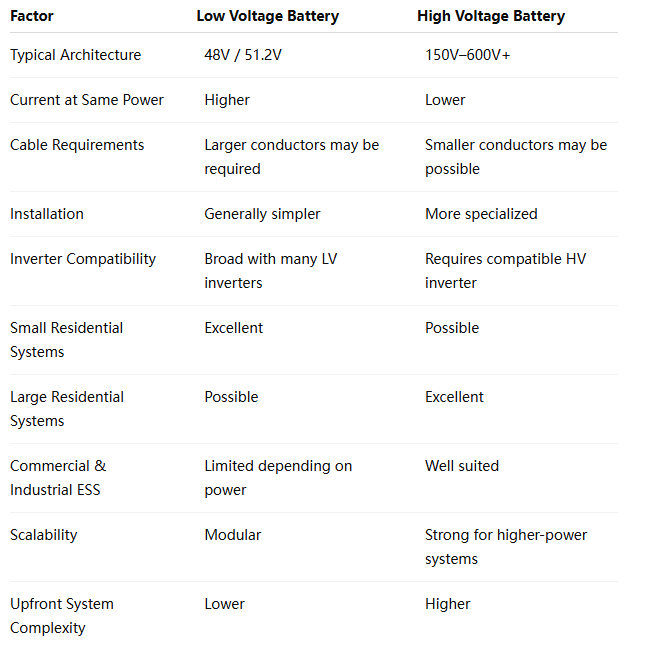
Voltage ranges vary by battery manufacturer and system architecture; always follow the battery and inverter specifications.
The key principle is simple:
At the same power, increasing voltage reduces current.
The relationship is:
P = V × I
Therefore:
I = P ÷ V
For example, a 10kW system operating around 50V requires substantially more current than a 400V system delivering the same power. Lower current can reduce resistive losses and thermal stress in the DC power path.
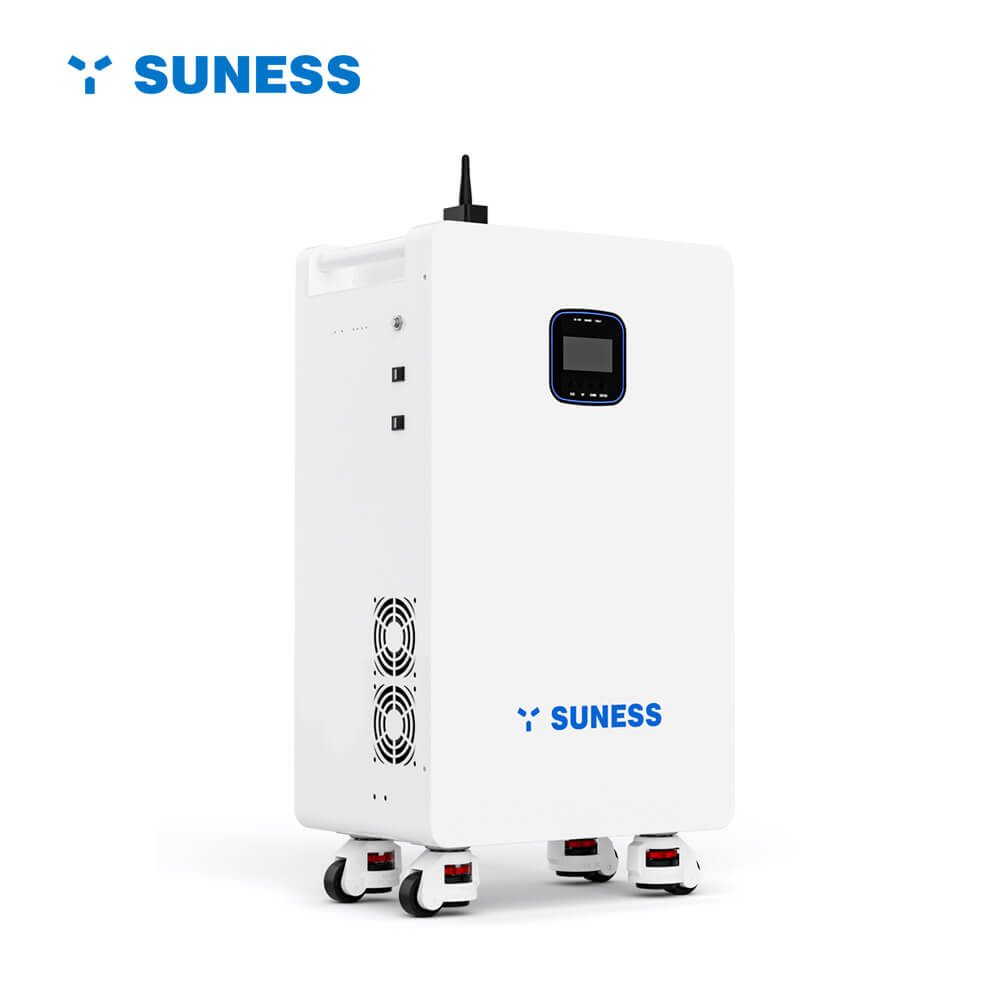
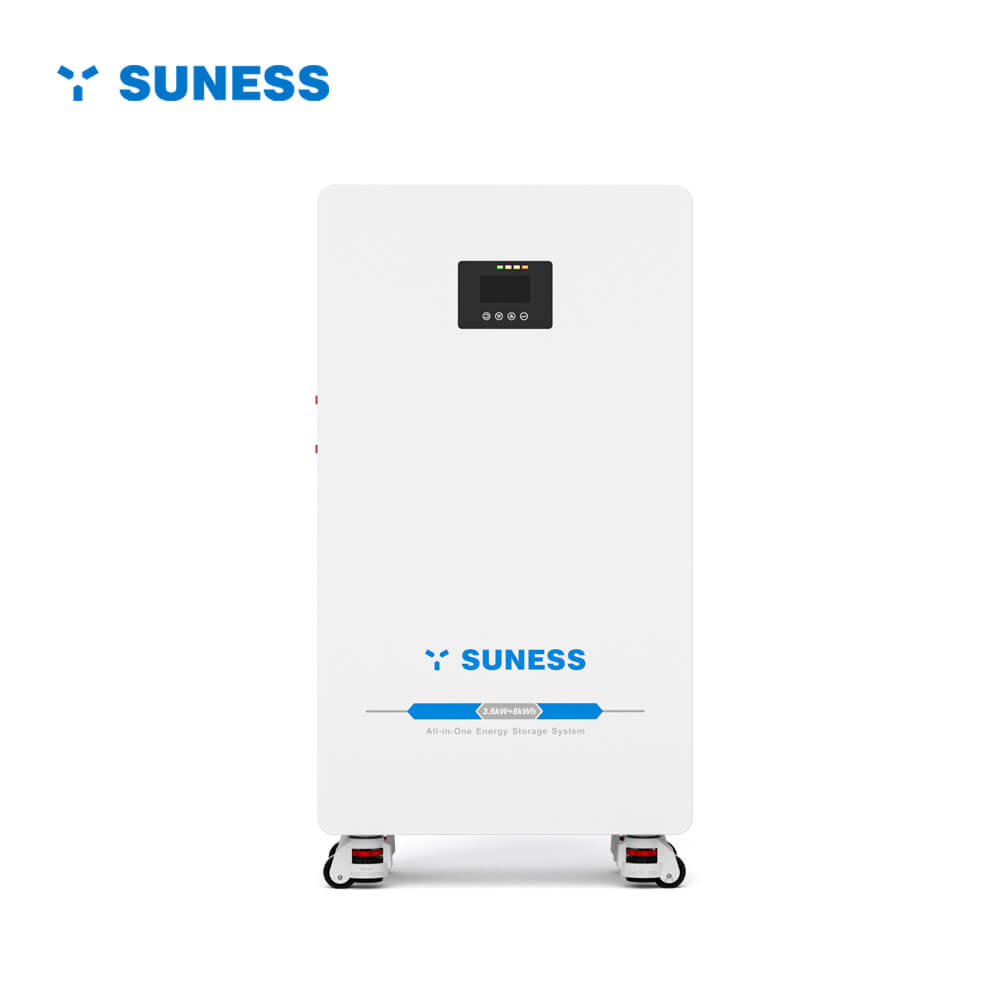
A low-voltage battery is commonly used in residential solar and energy storage systems. 48V and 51.2V LiFePO₄ battery systems are particularly common in home energy storage.
Low-voltage batteries are often paired with residential hybrid inverters and can be connected in parallel to increase total storage capacity.
For homeowners and installers working with relatively moderate power requirements, LV batteries can offer a practical balance between cost, performance, and installation simplicity. Recent 2026 comparisons continue to identify 48V-class systems as a common choice for smaller residential and retrofit applications.
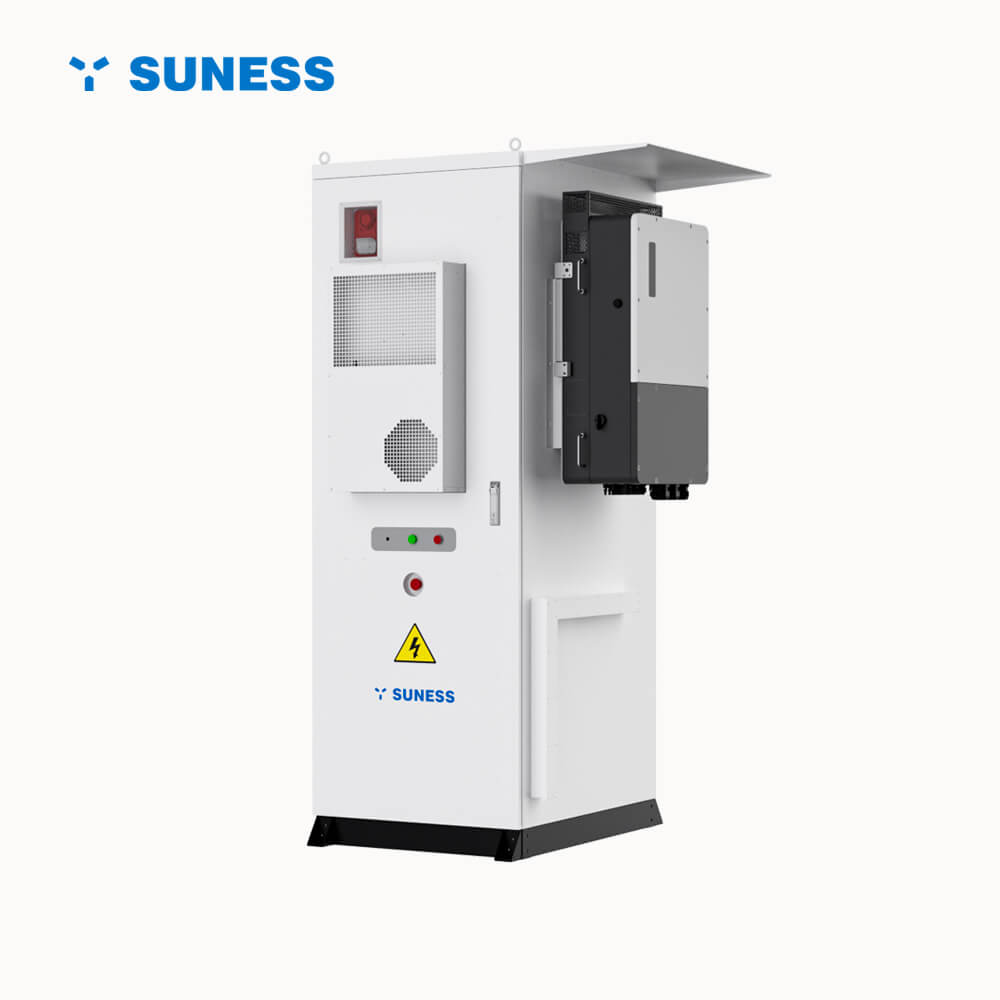
High-voltage battery systems use multiple battery modules connected in series to create a significantly higher DC voltage.
Depending on the system design, HV ESS batteries may operate from roughly 150V to 600V or higher. Larger commercial and industrial systems can use even higher DC voltage architectures.
High-voltage batteries are commonly considered for:
Recent industry comparisons consistently highlight lower current and reduced cable losses as major reasons to consider HV architecture for larger systems.
The biggest technical difference is not simply the voltage number.
It is the current required to deliver the same power.
For example:
10,000W ÷ 50V = 200A
10,000W ÷ 400V = 25A
The high-voltage system requires much less current to deliver the same power.
This matters because cable losses are related to current:
Power Loss = I²R
As current increases, resistive losses can increase significantly.
Therefore, higher-voltage battery architectures can be advantageous when the system needs to deliver substantial power over the DC connection.
Cable selection is one of the practical issues installers need to consider.
A low-voltage battery delivering high power may require a higher current rating and therefore larger DC conductors.
A high-voltage system delivering the same power can operate at lower current, potentially reducing conductor requirements and associated losses.
However, cable size should never be selected simply based on voltage.
Installers should consider:
This is particularly important for commercial and industrial ESS installations.
One of the strongest arguments for HV batteries is efficiency.
Because high-voltage systems can deliver the same power at lower current, they can reduce resistive losses in the DC path.
However, it would be inaccurate to say that every HV battery is automatically more efficient than every LV battery.
Actual system efficiency depends on:
Therefore, installers should compare the complete ESS system, rather than looking only at battery voltage.
This is one of the most important considerations for installers.
A battery must operate within the compatible voltage range of the hybrid inverter or PCS.
For example:
LV Battery → LV Hybrid Inverter
HV Battery → HV Hybrid Inverter
An HV battery cannot simply be connected to an LV inverter because the voltage architecture is different.
Before selecting a battery, installers should check:
Battery compatibility should always be confirmed before installation.
LV systems generally have a simpler architecture and can be easier for installers to configure, service, and expand.
This can be particularly attractive for:
HV systems can provide better power density and lower-current operation, but they require greater attention to system architecture, insulation, protection, commissioning, and compatible equipment.
As voltage increases, installation should be handled according to the applicable electrical standards and manufacturer requirements.
For a typical residential system, the answer depends on the home's power demand.
Recent 2026 guides generally describe LV systems as practical for smaller residential systems, while HV systems become increasingly attractive as system power and scale increase.
For larger commercial and industrial applications, HV architecture can offer important advantages.
Commercial ESS projects often have:
At higher power levels, reducing DC current can help manage cable losses, thermal requirements, and system design.
Therefore, HV batteries are often a strong choice for C&I energy storage, although the final architecture should be determined by the PCS/inverter, battery design, project requirements, and applicable regulations.
The cheapest battery is not necessarily the cheapest energy storage system.
When comparing LV and HV systems, installers and project developers should consider the total cost of ownership (TCO).
Important cost factors include:
A low-voltage system may have a lower initial cost, while a high-voltage system may provide advantages for higher-power applications.
Therefore, the better question is:
Which battery architecture delivers the lowest total cost for the required power and energy?
Use this simple decision guide:
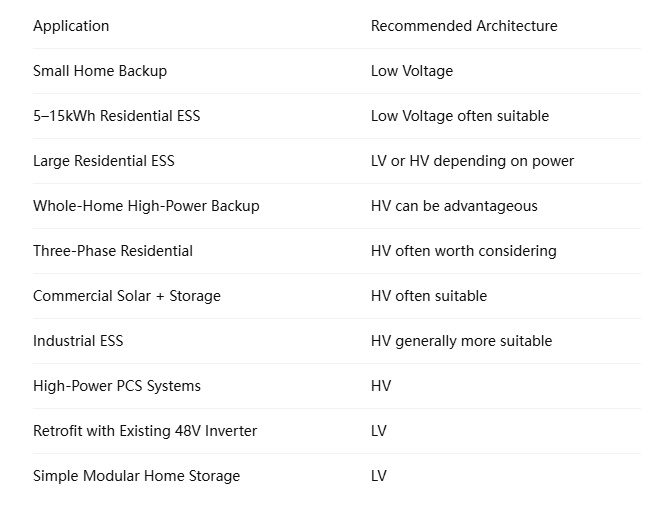
This is a general guide. The final choice should always be based on the inverter, load profile, battery architecture, local regulations, and project economics.
Safety depends on the complete system design—not simply whether the battery is LV or HV.
A modern LiFePO₄ energy storage system should include appropriate:
Low-voltage systems generally present lower electrical voltage at the battery terminals, which can simplify some installation and servicing scenarios.
High-voltage systems, meanwhile, require stricter safety procedures because the DC voltage is significantly higher.
For either architecture, installers should follow the manufacturer's installation instructions and applicable electrical codes.
No.
This is one of the most important points for homeowners and installers.
HV batteries are advantageous when:
LV batteries can be better when:
Recent 2026 industry guides similarly emphasize that voltage selection should be based on system size, inverter compatibility, power demand, installation environment, and budget—not on voltage alone.
SUNESS provides energy storage solutions covering different application requirements, from low-voltage residential batteries to high-voltage stacked energy storage systems.
The goal is not to use the highest voltage possible, but to match the battery architecture with the customer's:
Power demand + Energy capacity + Inverter + Application + Expansion requirements
For installers and distributors, this provides greater flexibility when designing residential, commercial, and renewable energy storage projects.
Not necessarily. High-voltage batteries are generally better suited to high-power and larger energy storage systems, while low-voltage batteries are often practical for smaller residential and backup applications.
Yes. In residential energy storage, 48V and 51.2V battery systems are commonly considered low-voltage architectures.
They can reduce current and associated resistive losses at the same power level. However, total system efficiency also depends on the inverter, battery, cables, conversion stages, and operating conditions.
For smaller residential systems, low-voltage batteries can be a practical choice. For larger homes with high power demand, whole-home backup, or three-phase systems, high-voltage batteries may be more suitable.
It can, depending on the battery's continuous current rating, the number of battery units, inverter architecture, and system configuration. However, high-power systems may benefit from a higher-voltage architecture because it reduces the current required for the same power.
No. Battery voltage range, BMS communication protocol, charge/discharge current, CAN/RS485 communication, and inverter compatibility must all be checked before installation.
High voltage is not automatically better, and low voltage is not outdated.
The right battery voltage depends on the size and purpose of the energy storage system.
For smaller residential systems, LV batteries offer simplicity, flexibility, and broad compatibility. For larger residential, commercial, and high-power applications, HV batteries can provide lower current, better scalability, and an architecture suited to higher power requirements.
For installers and distributors, the best approach is to select the battery after evaluating the inverter, load profile, storage capacity, cable requirements, installation conditions, and future expansion plan.
That is the key to building a reliable and cost-effective solar + storage system.
Leave Your Message
Enterprise Core Values
Passion,Strive,Pragmatism,Promising
Corporate Vision
To become a global leader in smart energy storage
Corporate mission
Let clean energy enter thousands of households